Overview
My master's thesis focused on the design and implementation of multivariate analysis algorithms for fMRI data, specifically a complete Searchlight Representational Similarity Analysis (Searchlight RSA) pipeline. I implemented these algorithms from scratch and integrated them into the neuroimaging toolbox QuNeX, ensuring they were efficient, modular, and reusable within an existing large-scale analysis framework.
Searchlight Algorithm
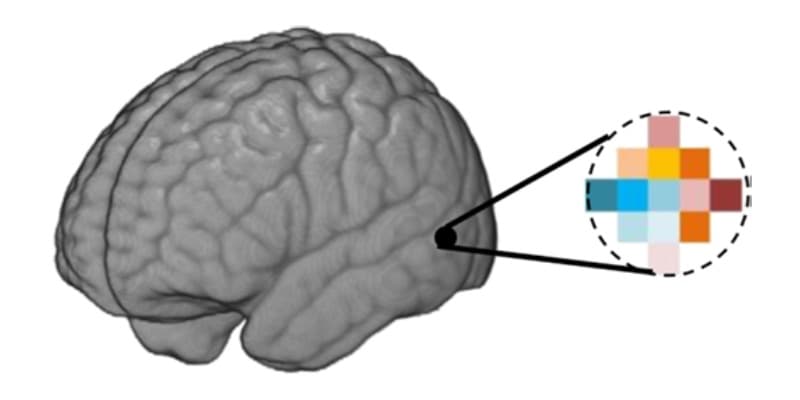
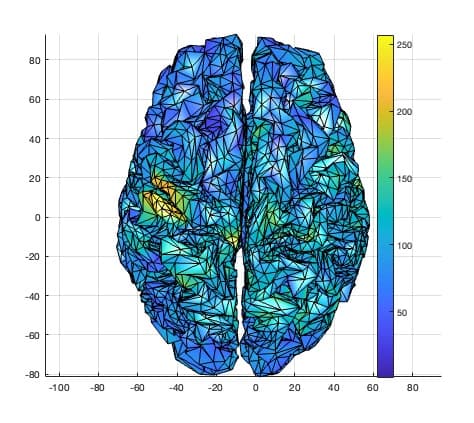
The first component was the searchlight algorithm, which systematically traverses the cortical surface and constructs local neighborhoods around each node to extract multivariate activation patterns. Rather than operating on volumetric voxels, the fMRI data were projected onto a cortical surface representation, where the cortex is modeled as a mesh (graph) of vertices connected by edges.
Running the searchlight on this surface-based representation improves the anatomical specificity of local neighborhoods, avoids mixing signals across cortical folds, and increases the accuracy and sensitivity of multivariate pattern analysis methods. Implementing this required efficient traversal of mesh-based data structures, spatial neighborhood definition, and careful handling of high-dimensional data.
Representational Similarity Analysis
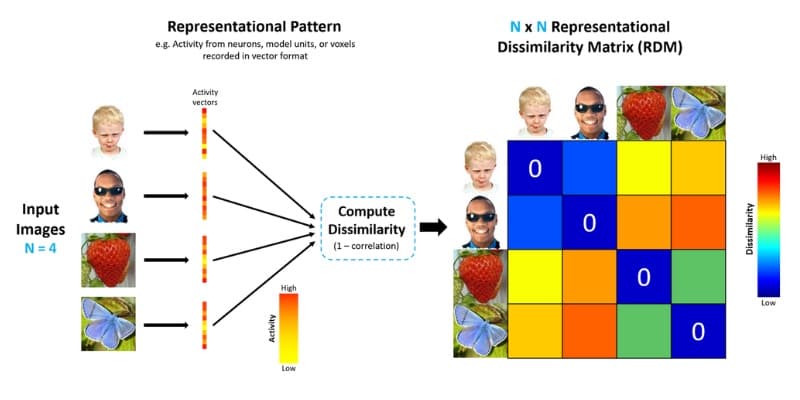
The second component was Representational Similarity Analysis (RSA), where trial-wise neural activation patterns are converted into similarity matrices using Pearson correlation and compared against model-based similarity matrices using Spearman correlation. The resulting similarity scores are assigned back to the searchlight center vertex, producing whole-brain information maps that support condition-wise and group-level statistical comparisons.
Application & Results
I applied this pipeline to an existing visuospatial working memory fMRI dataset, running the analysis separately for two task conditions that biased participants toward different encoding strategies. Using the implemented methods, I identified condition-specific differences in how stimulus location was represented across cortical regions, demonstrating how these algorithms can be used to extract meaningful representational structure from complex, high-dimensional data.